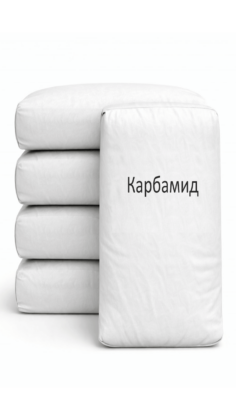
Carbamide ( urea ) - an organic compound, but it is classified as mineral (nitrogen) fertilizers. It dissolves well in water.
Urea produce brands in Russia A and B. Conventionally, the application can be divided as follows:
Mark B is used in agriculture - increases yield, raises gluten of cereals (wheat). Increases the nitrogen content. It is produced in granules, which prevents caking. As a special property when used as a fertilizer - does not cause burns of plant leaves. However, when the concentration is increased near the seed, the germination strongly decreases. To level this property, potassium fertilizers should also be used or a soil layer should be provided. In addition, urea derivatives are effective herbicides that fight weeds.
In animal husbandry it is used as a protein substitute in cattle feeds.
Mark A is used in various industries, as well as in medicine.
Some manufacturers have unified the carbamide - it is suitable for both industry, and for agriculture and livestock.
It is used for filtering smoke gases of CHP plants and incineration plants from nitrogen oxides.
It is used as an additive to concrete.
Used as a corrosion inhibitor, as an antiseptic in woodworking.
It is registered as food additive E927b, which works, for example, in the production of chewing gum.
Influence on the human body:
Urea for the human body has a dehydrating and diuretic property. Also, general cleaning activities on the tissue and the body as a whole. When used as a part of cosmetic products, it kills germs and bacteria.
Want to order this product now? Call us: +7 (495) 133-02-40
or send a request info@chimko.com
Application:
in the industry as a raw material in the manufacture of resins, adhesives, etc., in agriculture as a mineral N fertilizer, livestock as a feed additive.
Frequently asked questions (FAQ) about Carbamide (urea) techn.
What is the shelf life of carbamide?
The shelf life stated by the manufacturer is usually 6 months from the date of production, but with proper storage it retains its properties significantly longer. Carbamide must be protected from moisture: even the slightest contact with moisture causes the granules to stick together into a solid mass, after which dissolving them for spraying becomes problematic. If the preparation is stored in sealed packaging in a dry room, it does not lose its nitrogen percentage for years.
Are carbamide and urea the same thing?
Yes, in plant growing these two names refer to the identical nitrogen fertilizer. The confusion arises only from the origin of the words, but their chemical composition is the same, so in practice there is no difference in which name appears on the packaging.
Both terms refer to the diamide of carbonic acid with a nitrogen content of 46%. The traditional name “urea” comes from the organic product, while “carbamide” is the technical name that became established in industry.
How should an agricultural enterprise properly fertilize with carbamide?
Carbamide is most often used during the period of active crop growth, when plants need available nitrogen. In production schemes it is applied before sowing, in early vegetation phases, between rows, in the trunk zones of commercial orchards, or through solution units if provided for by the technology. Autumn application is limited so as not to trigger excess growth of green mass and not to lose nitrogen through leaching or volatilisation. The specific timing depends on the crop, soil temperature, moisture and the nutrition system.
How to fertilize with carbamide in spring?
When using urea in spring, it is important to catch the phase of high crop demand. Before sap flow begins, an eradicating wash of the crown is carried out with a concentrated solution, and after the leaves open, feeding with carbamide over the foliage is done at a reduced dose. Root feeding is carried out once the soil has warmed to at least +10°C, working the preparation into the trunk circles or row spacing before rain or irrigation.
When is the best time to feed plants with carbamide?
The timing for feeding with this compound should be guided by the phase of active growth. For fruit trees and berry bushes, the optimal time is considered to be early spring right after snowmelt and the period of fruit set. Vegetable crops respond well to application when they are building vegetative mass. The main thing is not to carry out the procedure during the dormancy phase and right after harvest, so as not to trigger an unnecessary autumn flush of greenery.
How to properly dilute urea for spraying trees and spring feeding?
To understand how the urea working solution is prepared, you need to consider the purpose of use. First, the urea is dissolved in water: the granules are poured into warm liquid and actively stirred until clear. If foliar feeding is needed, the concentration is made weaker (30–50 g per bucket), while for tree treatment a higher dosage of urea is used. A separate nuance is correctly diluting the preparation for spraying trees: before bud break, a 7–10 percent solution is prepared (700–1000 g per 10 L) to destroy overwintering pests. In spring, a gentler option is also practised — spraying trees with urea at the green cone stage using a 5 percent mixture. Understanding how to dilute the fertilizer for spring tree spraying is straightforward: the main thing is to wait until the granules have completely dissolved, otherwise burns cannot be avoided. Agronomists recommend applying urea to trees in spring twice — first for sanitary purposes, then as a nutritional treatment.
At what temperature does carbamide work more effectively?
The action of carbamide is strongly tied to ambient temperature. The enzymatic conversion process into available ammonium starts once the soil warms to +8…+10°C, but the highest efficiency occurs at +15°C and above. In cold weather, spraying is also used, but in this case it acts more as a contact treatment rather than a feeding. The warmer it is outside, the faster urea is absorbed by the leaves and roots.
What is the difference between saltpetre and carbamide (urea)?
The key difference between saltpetre and carbamide lies in how exactly plants obtain nitrogen. Ammonium nitrate consists of 34.4% nitrogen in two forms — fast-acting nitrate and more gradual ammonium. Carbamide fertilizer differs from ammonium nitrate in its higher concentration (46%) and the amide nature of its active substance. Comparing how carbamide differs from saltpetre, one cannot fail to mention speed: saltpetre works even in cold soil, whereas carbamide (urea), unlike ammonium nitrate, depends on the activity of soil bacteria, which require warmth. Another nuance — in foliar feeding it is urea that acts as the gentler option, while saltpetre can burn foliage, so their intended use differs somewhat.
Delivery and payment
Every minute matters so your production doesn't stand idle. That's why we've built our logistics so that ordering and receiving our reagents is easy, and delivery times are predictable.
Delivery terms
We deliver across Russia. We've built our processes so that distance is not an obstacle to a fast delivery.
1
Choosing a carrier: We work with trusted transport companies. Choose the one you trust — we will ship your cargo with it.
2
To your warehouse or pickup: We will deliver the batch directly to your warehouse. Or, if it's more convenient, pick it up yourself from ours.
3
Speed: In most regions, delivery takes from 1 to 7 business days. Need it faster? We can discuss urgent options.
Payment terms
We understand that convenience also means flexible payment. That's why we offer different options:
1
Bank transfer for organizations against an issued invoice.
2
Online payment for fast processing.
3
This is the fastest way: you pay — and your order immediately goes into work.