Send request
Call us at +7 (495) 133-02-40 right now!
Send a request to order@chimko.com or use our feedback form.
colorless liquid with a characteristic pungent odor.
ADR 8
by covered transport
in closed, well-ventilated warehouse premises
|
Indicator name |
Analysis results |
|
Mass fraction of acetic acid, % |
99.9 |
|
Mass fraction of impurities, %: |
|
|
Acetaldehyde |
none |
|
Formic acid |
0.019 |
|
Non-volatile residue |
0.002 |
| Sulfates | 0.0001 |
| Chlorides | 0.0001 |
| Iron | 0.0001 |
| Heavy metals | 0.00008 |
| Arsenic | 0.00005 |
| Substances oxidizable by potassium dichromate calculated as oxygen |
0.005 |
| Sulfuric acid test | passes |
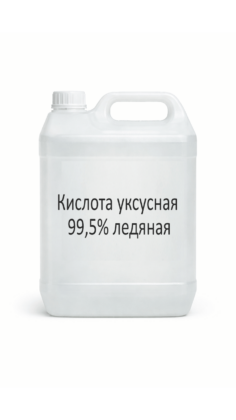
Acetic acid 99.5% ("glacial") is a colorless liquid that crystallizes as temperature drops, with a characteristic pungent odor and high titratable acidity. The 99% concentration ensures a minimal water trace and predictable behavior in syntheses and process operations where precise stoichiometry matters. The material gives clean solutions, doses well on automated units, and stably retains its parameters when stored correctly. We offer acetic acid per GOST for sale — batches in stock and to order, with a quality certificate and stable parameters. This format is convenient as a universal raw material: it is easy to dilute to working concentrations, and the consistency of composition reduces the risk of formula adjustments and line downtime.
GOST 61-75 sets requirements for high-concentration acetic acid on key parameters: mass fraction of the main substance, color, transparency, aldehyde content and other controlled components, as well as safety and labeling standards. The document describes analysis methods, sampling and combining rules, acceptance procedure, storage and transportation conditions. Uniform procedures make laboratory results comparable between sites, and clear tolerances help buyers and technologists quickly check the batch certificate against the standard. Tying the product to GOST simplifies incoming inspection, reduces the likelihood of disputed interpretations, and allows the raw material to be put into existing regulations without additional approvals.
The industrial route includes catalytic carbonylation of methanol to produce acetic acid, followed by multi-stage purification and drying to a concentration of 99.5%. The stream is stabilized by acidity, trace impurities are removed by rectification and fine filtration, after which the temperature is adjusted and the product is packaged into chemically resistant containers. Control covers the mass fraction of the main substance, color, transparency and safety parameters. This approach ensures reproducible properties when diluted to working concentrations, correct compatibility with standard solvents, and predictable reactivity in syntheses where dose accuracy and reagent purity are critical for yield and product quality.
Neutralisation of 99.5% glacial acetic acid requires an especially careful approach, because the product has a high concentration and can produce a noticeable heat effect when mixed with alkalis. At the enterprise, neutralisation of acetic acid is carried out only in a chemically resistant container, with stirring, pH control and according to an approved instruction. The alkaline reagent is added gradually, avoiding overheating, splashing and the concentrate getting into the sewer. After the reaction is complete, the residue is checked by pH and handed over for further treatment or disposal according to internal regulations.
A request for protection when working with acetic acid at 99.5% concentration means a full set of industrial safety measures. When decanting, dosing and preparing solutions, personnel use chemically resistant gloves, safety goggles or a face shield, protective clothing and working ventilation. The vapours of glacial acid irritate the respiratory tract, and contact of the concentrate with skin or mucous membranes can cause a chemical burn. Therefore 99.5% glacial acetic acid must only be handled by trained personnel, in labelled containers, and without mixing with incompatible substances outside the regulations.
Storage of 99.5% glacial acetic acid is organised in sealed factory packaging, in a ventilated room, separately from alkalis, strong oxidisers and heat sources. It should be taken into account that glacial acetic acid can crystallise when cooled, so the warehouse conditions must comply with the safety data sheet and the manufacturer’s requirements. For a wholesale buyer, storing acetic acid includes checking the labelling, container integrity, production date, quality certificate and the availability of spill containment means. The storage area must be restricted to unauthorised persons and clear to personnel working with chemical raw materials.
Safety with high-concentration acetic acid begins already at the stage of batch acceptance: documents, packaging, labelling, concentration and compliance with the enterprise’s internal specification are checked. When using 99.5% glacial acetic acid, it is important to exclude accidental mixing with alkalis, oxidisers and unsuitable container materials. Rules must be established for production regarding decanting, dilution, neutralisation of acetic acid, spill collection and disposal of contaminated residue. This approach reduces the risk of burns, equipment damage, process instability and emergency situations in the warehouse.
Neutralisation of acetic acid with sodium hydroxide is based on converting the acid into sodium acetate and water. If 99.5% glacial acetic acid is used, the process is carried out with increased control: sodium hydroxide is dosed in small portions, the solution is continuously stirred and the temperature is monitored. Concentrated reagents must not be mixed abruptly, because local boiling, foaming and splashing are possible. For production tasks it is important to calculate the amount of alkali in advance, set the target pH and prepare containment means in case of a spill.
The acetic acid neutralisation reaction is the interaction of the acid with a base, producing a salt and water. When sodium hydroxide is used, the final product is sodium acetate. For the process engineer it is important to take into account not only the chemical equation but also the concentration of the starting material: 99.5% glacial acetic acid is much more aggressive to handle than diluted solutions. Therefore the acetic acid neutralisation reaction in industry must be carried out with dosing, stirring, temperature control and mandatory checking of the final pH.
Every minute matters so your production doesn't stand idle. That's why we've built our logistics so that ordering and receiving our reagents is easy, and delivery times are predictable.
We deliver across Russia. We've built our processes so that distance is not an obstacle to a fast delivery.
Choosing a carrier: We work with trusted transport companies. Choose the one you trust — we will ship your cargo with it.
To your warehouse or pickup: We will deliver the batch directly to your warehouse. Or, if it's more convenient, pick it up yourself from ours.
Speed: In most regions, delivery takes from 1 to 7 business days. Need it faster? We can discuss urgent options.
We understand that convenience also means flexible payment. That's why we offer different options:
Bank transfer for organizations against an issued invoice.
Online payment for fast processing.
This is the fastest way: you pay — and your order immediately goes into work.
Call us at +7 (495) 133-02-40 right now!
Send a request to order@chimko.com or use our feedback form.