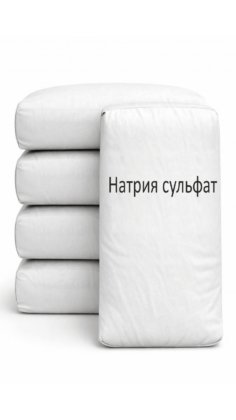
White powder or granules, a grayish tint is acceptable.
Formula:
Na2SO4
Hazard class:
none
Transportation conditions:
by covered transport
Storage conditions:
in dry unheated warehouse premises
Shelf life:
6 months
Sodium Sulfate
GOST 6318-77
Specification:
Indicator name
Grade A
Grade B
Premium
First
Second
Appearance
White powder or granules, a grayish tint is acceptable
White powder, a grayish tint is acceptable
Sodium sulfate (Na2SO4), %, not less than
99.4
98
97
94
Water-insoluble residue, %, not more than
0.4
0.9
1.2
4.5
Chlorides calculated as sodium chloride (NaCl), %, not more than
0.2
0.7
1.2
2.0
Calcium sulfate (CaSO4), %, not more than
—
—
—
1.0
Magnesium ions (Mg2+), %, not more than
0.02
0.1
0.2
—
Iron calculated as Fe2O3, %, not more than
0.01
0.015
0.03
0.03
Water, %, not more than
0.1
1.0
4.0
7.0
Description of characteristics
Sodium sulfate (sodium sulphate) per GOST 6318-77 is a stable mineral product with a uniform crystalline structure and predictable process behavior. Sodium sulfate doses well, retains flowability when stored properly, and is supplied in industrial packaging with a quality certificate for each batch. For companies planning to buy the material wholesale, repeatability of chemical parameters and transparent logistics conditions are important — these parameters are ensured by standard control and labeling procedures. The price is calculated individually, taking into account volume, distance and shipment schedule. If you need to buy raw material for a continuous cycle, we can coordinate deliveries to match your production plan to avoid downtime and formula adjustments.
GOST 6318-77
GOST 6318-77 sets mandatory requirements for sodium sulfate: the standardized mass fraction of the main substance, permissible levels of impurity ions, appearance and solubility parameters, as well as rules for sampling and combining samples for laboratory control. The document specifies packaging types, labeling procedures, storage and transportation conditions, which ensures batch traceability from production to consumer and minimizes the risk of moisture ingress or contamination along the way. Uniform analysis methods make results from different laboratories comparable, and acceptance and periodic testing procedures maintain quality stability over time. For the buyer, this means an objective assessment of the material before it is included in a formulation, and confidence that the product will behave the same from delivery to delivery.
Production method
Sodium sulfate is obtained both from natural raw materials and by synthetic routes. A common scheme is the processing of mirabilite, converting hydrated forms to the anhydrous state through controlled drying and subsequent classification by fraction. In the chemical route, reactions with sulfuric acid and sodium salts are used; a typical industrial implementation ensures simultaneous removal of volatile by-products and formation of a solution with a set concentration, from which the sulfate is separated by crystallization. This is followed by washing the crystals, drying, particle size stabilization and final quality control according to the parameters specified in GOST 6318-77. This approach produces a product with stable characteristics, convenient for scalable technological processes.
Application:
In glass production, Na2SO4 is mainly used as a clarifying additive.
Sodium sulfate is also used as a concrete additive to increase the hardening rate at early curing stages. Optimal application is 1-2% of mass.
Solutions of sodium sulfate with water are used to accumulate thermal energy (for example, in greenhouse operations). In livestock farming and agriculture it is also used as a feed additive for animals and in the chemical drying of seeds.
Additional areas of application:
In pulp and paper production;
Leather industry;
Textile industry;
Food production — additive E514;
Chemical industry;
For non-ferrous metallurgy needs;
In medical and veterinary purposes;
In the production of synthetic detergents.
Precautions:
The powder is virtually safe.
May irritate skin and mucous membranes with prolonged contact.
If ingested, causes diarrhea and has laxative properties, which is used in medicine.
Frequently asked questions (FAQ) about Sodium Sulfate
How to identify sodium sulfate during incoming batch inspection?
Visually, the product looks like a white crystalline powder or granules with no pronounced smell, but appearance alone cannot confirm the substance with certainty. At an enterprise, sodium sulfate is identified by accompanying documents, quality certificate, container labelling and laboratory results. If necessary, an analysis for the sulfate ion and sodium is carried out, and solubility, the mass fraction of the main substance, moisture content and the presence of insoluble impurities are checked.
How to dilute sodium sulfate for a working solution?
To understand how to dilute sodium sulfate, the required concentration, solution volume and the requirements of the process regulations are determined first. The dry product is poured into clean water in small portions with constant stirring, achieving complete dissolution without sediment at the bottom of the container. For a stable result it is important to take into account water temperature, container cleanliness and the quality of the source material. If the sodium sulfate solution is prepared for a further production process, it is checked for clarity, concentration and absence of foreign inclusions before use.
What are the storage conditions for sodium sulfate in a warehouse?
The storage conditions for sodium sulfate are fairly simple, but they must be observed for wholesale batches. The product is kept in a dry, ventilated room, in sealed factory packaging, on pallets and protected from moisture ingress. If it gets wet, sodium sulfate can cake, become harder to dose and create difficulties when preparing solutions. Containers should be protected from damage, and batches stored with labelling and documents preserved, so as not to lose traceability of the raw material in the warehouse.
What is the shelf life of sodium sulfate for wholesale batches?
The shelf life of sodium sulfate depends on the manufacturer’s requirements, the product grade and storage conditions, so the exact period should be checked in the quality certificate or specification for the specific batch. The substance itself is fairly stable, but if warehouse conditions are violated it can absorb moisture, cake and become contaminated with foreign impurities. For the buyer, what matters is not only the formal shelf life of sodium sulfate but also the actual state of the product: free-flowing quality, packaging integrity, absence of contamination and compliance with laboratory results.
Delivery and payment
Every minute matters so your production doesn't stand idle. That's why we've built our logistics so that ordering and receiving our reagents is easy, and delivery times are predictable.
Delivery terms
We deliver across Russia. We've built our processes so that distance is not an obstacle to a fast delivery.
1
Choosing a carrier: We work with trusted transport companies. Choose the one you trust — we will ship your cargo with it.
2
To your warehouse or pickup: We will deliver the batch directly to your warehouse. Or, if it's more convenient, pick it up yourself from ours.
3
Speed: In most regions, delivery takes from 1 to 7 business days. Need it faster? We can discuss urgent options.
Payment terms
We understand that convenience also means flexible payment. That's why we offer different options:
1
Bank transfer for organizations against an issued invoice.
2
Online payment for fast processing.
3
This is the fastest way: you pay — and your order immediately goes into work.