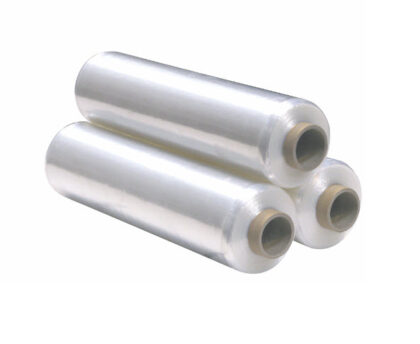
Roll weight - 2 kg Roll width - 500 mm Winding length - 230-240 m Film thickness - 20-23 microns Secondary, hand
Stretch Film
Specification:
Value
Packaging
box of 6 rolls
Roll weight
2 kg
Film type
secondary, clear, for hand palletizing
Film thickness
20-30 microns
Roll width
500 mm
Winding length
230-240 m
Description of characteristics
Stretch film is the most widespread packaging material, used in almost all industrial and household applications. It is made from low-density polyethylene (LLDPE). The name comes from the English word "stretch," meaning elongation or stretching.
Its biggest advantage over other types of packaging is reversible stretching of up to 300 percent, while retaining its properties — the ability of layers to cling to each other, tear resistance and puncture resistance. Specialists call this reversible stretching "pre-stretch." For example, stretching to 300 percent is the ability to stretch one meter to a length of 4 meters.
The second most important property is the ability of the layers to cling together when wound. This provides protection from external contaminants and moisture. Also, unlike, for example, adhesive tape, it leaves no residue.
Classification
By type of use:
Hand stretch film — no special equipment is required for use. Suitable for warehouse work and any product packaging.
Machine stretch film — used in mechanical and electrical pallet wrappers to create rotational wrapping.
By color:
Clear — cheaper than colored film. Allows you to visually assess the integrity of the cargo and check the product name.
Black — prevents exposure of the product to ultraviolet radiation.
Colored — used for decoration, as well as for rotational processing in warehouses with a large assortment.
By size:
Film thickness — from 9 to 35 microns. Up to 10 microns is used as a protective layer between batches of finished goods. Up to 17 microns — in the food industry. 20-23 microns holds loads well on a pallet. Thicknesses over 23 microns are used for securing special and heavy loads.
Roll length — can vary widely depending on usage needs. Machine rolls are much longer than hand rolls, since with hand use a roll weighing more than 2-3 kilograms becomes inconvenient to handle.
Product width — can vary widely depending on usage needs.
Roll weight varies depending on other parameters and is a consequence of them. Although in most cases the price of stretch film is quoted per kilogram.
By raw material type:
Primary — produced according to GOST.
Secondary — produced from recycled raw material; GOST does not apply to such products. Made from recycled primary film. Its characteristics differ from primary film. But the price of secondary film is lower, which is especially noticeable in wholesale purchases of stretch film.
Mix — production combines technologies of both primary and secondary processing.
Difference between primary and secondary
The quality of the final product is directly proportional to the type of raw material used in production. Primary film is a transparent material, with no specific odor, and high stretch performance. It is a universal material, used, among other things, in the food industry and medicine.
Recycled raw material is used to produce secondary film. The quality of this film is somewhat lower. It usually has a yellowish or grayish tint and an uneven surface. This difference in characteristics is offset by a lower price. Secondary film is used with some restrictions — it is not used in catering, medicine and food production in cases where direct contact with the product is possible. It should also be noted that secondary film stretches somewhat worse.
Secondary film is used to protect static objects and cargo transported on a pallet without the possibility of creating critical loads on the packaging material.
Frequently asked questions (FAQ) about Stretch Film
What is the melting point of oleic acid B-115?
The melting point of oleic acid depends on its purity, the composition of the fatty acid fraction and the specific product grade. For pure individual oleic acid, a reference melting point of around +13…+14°C is usually given, but oleic acid B-115 is a technical product, so the actual figure is best checked against the batch quality certificate. If the raw material is stored at a reduced temperature, it can become cloudy, thicken or partially crystallise, which does not always mean a loss of properties. Before use, the product is usually brought to the working temperature of the warehouse or workshop.
What is the boiling point of oleic acid?
The boiling point of oleic acid may be stated differently in reference sources, because fatty acids are sensitive to oxidation and thermal changes under strong heating. For the pure substance, high values are given, approximately in the range of 350–360°C at atmospheric pressure, while laboratory practice often uses data at reduced pressure. For oleic acid B-115 in production, what matters more is not to bring the product to overheating, but to observe the temperature regime specified by the supplier, so as not to worsen the colour, smell, acid number and stability of the raw material.
What is the water solubility of oleic acid?
The water solubility of oleic acid is extremely low: it is a hydrophobic fatty acid that practically does not mix with water, but dissolves in many organic media. When an attempt is made to mix it with water without an emulsifier, a separate oily phase usually forms. This is important to take into account when preparing process formulations: for even distribution of oleic acid B-115, a suitable solvent, alkaline neutralisation forming oleates, or an emulsifying system may be required. Reference descriptions also classify oleic acid as a water-insoluble substance.
How to use oleic acid B-115 in a process?
The question of how to use oleic acid needs to be resolved through the regulations of a specific production process. Before feeding it into the process, the product’s temperature, uniformity, absence of mechanical impurities, container condition and quality certificate data are checked. If the raw material has thickened after cold storage, it is not abruptly overheated, but brought to working fluidity through controlled heating, if this is permitted by the documentation. Dosing is carried out by weight or volume, taking into account the acid number, moisture content, colour and the requirements of the finished formulation.
How to organise storage of oleic acid B-115?
Storage of oleic acid requires sealed containers, away from moisture, direct heating, open flame, strong oxidisers and contaminating impurities. The warehouse must ensure the preservation of packaging, labelling and batch traceability. At low temperature the product can become more viscous or cloudy, so its condition is assessed visually and against the quality certificate before use. For large batches it is important not to mix residues from different deliveries without control, since the shade, acid number and composition of the fatty acid fraction can differ.
What is the shelf life stated for a technical batch of oleic acid?
The shelf life of oleic acid is set by the manufacturer or supplier in the documents for a specific batch. For the technical grade B-115, it is important to observe storage conditions: sealed containers, protection from overheating, light, moisture and contact with oxidisers. If conditions are violated, the product can darken, change smell, oxidise and deviate from quality parameters. Therefore, when purchasing wholesale, buyers rely not only on the calendar period but also on the actual condition of the raw material: colour, clarity at working temperature, acid number and compliance with the certificate.
Delivery and payment
Every minute matters so your production doesn't stand idle. That's why we've built our logistics so that ordering and receiving our reagents is easy, and delivery times are predictable.
Delivery terms
We deliver across Russia. We've built our processes so that distance is not an obstacle to a fast delivery.
1
Choosing a carrier: We work with trusted transport companies. Choose the one you trust — we will ship your cargo with it.
2
To your warehouse or pickup: We will deliver the batch directly to your warehouse. Or, if it's more convenient, pick it up yourself from ours.
3
Speed: In most regions, delivery takes from 1 to 7 business days. Need it faster? We can discuss urgent options.
Payment terms
We understand that convenience also means flexible payment. That's why we offer different options:
1
Bank transfer for organizations against an issued invoice.
2
Online payment for fast processing.
3
This is the fastest way: you pay — and your order immediately goes into work.