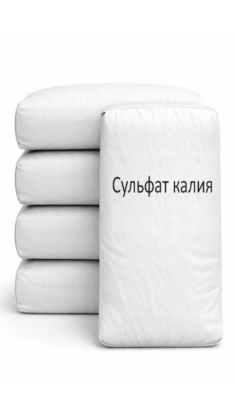
Appearance:

colorless crystals

Formula:
K2SO4
Potassium sulphate
TU 2184-093-43499406-2001
Product quantity
(Number of packages)
Packaging:
bag 25 kg
Specification:
Parameter name Value
Mass fraction * of potassium salts in terms of K2O, %, min 50
Mass fraction * of free alkalinity in terms of Na2O, %, max 4,0
Массовая доля* хлоридов в пересчете на KCl, %, max 0,8
Mass fraction of water,%, max 0,5
* Standards are given in terms of dry matter.
Potassium sulphate

The main application - as a fertilizer. Kale sulfate

It is applied primarily to plants that are hypersensitive to chlorine.
Increases the saturation of vitamins obtained fruits.
It supplies plants with two compounds - Sulfur and Potassium.
In late summer - early fall, it is recommended for feeding fruit and perennial plants that improve their wintering.


Want to order this product now? Call us: +7 (495) 133-02-40
or send a request info@chimko.com

i

Information

Frequently asked questions (FAQ) about Potassium sulphate

How to correctly dissolve potassium sulfate in water for feeding?

To dissolve potassium sulfate in water, a measured amount of granules or powder is taken and poured into a container with warm liquid, stirring constantly. For root watering, 20–30 g is most often dissolved in 10 L of water, while a less concentrated solution is prepared for foliar treatment. Knowing how to dissolve potassium sulfate correctly helps avoid root burns while still giving plants readily available potassium. Complete dissolution occurs quickly, especially if large crystals are pre-crushed and ice-cold water is not used.

What can replace potassium sulfate, and is there an alternative to potassium sulphate?

When deciding what can replace potassium sulfate, agronomists consider several options. If the crop is not sensitive to chlorine, potassium chloride can be used; however, for chlorine-sensitive plants the best answer to “what can replace potassium sulphate” is potassium magnesium sulfate (kalimagnesia) or potassium nitrate. Monopotassium phosphate can also serve as a replacement, but it is noticeably more expensive and simultaneously supplies phosphorus, which is not always justified.

What does potassium sulfate provide and why do plants need it?

To understand what potassium sulfate provides, it is enough to look at the quality of the harvest after its application: fruit sweetness increases, and their keeping quality and resistance to transport improve. What potassium sulfate is needed for in most crops is to improve drought and frost resistance, since it regulates the water balance of cells. Looking at what this fertilizer does at the physiological level, it activates carbohydrate synthesis and the movement of nutrients. Potassium sulphate does the same, while also supplying the plant with sulfur, necessary for protein synthesis.

How to identify potassium sulfate and determine its authenticity?

The product appears as a fine crystalline powder, white or greyish in colour, resembling salt, without extraneous odour. To identify potassium sulfate, a sample can be dissolved in distilled water: the solution should remain clear, and adding barium chloride should produce an abundant white precipitate. Another way to identify potassium sulfate in field conditions is to introduce the crystals into a colourless flame, which will turn pale violet. A quality product contains no visible debris and dissolves completely without a cloudy suspension.

How to dissolve potassium sulfate quickly and without residue?

For fast dissolution, it is best to use heated water and continuous stirring. If the task is how to quickly dissolve potassium sulfate, the simplest approach is to first prepare a concentrated stock solution in a small volume of hot water, then dilute it to the working concentration. Those working out how to dissolve potassium sulfate in water in large volumes will find a mixer or circulation pump useful. At 20°C, a litre of water can accept about 110 g of the substance, but in cold liquid this process will be much slower.

Can potassium sulfate be mixed with urea and carbamide?

Combined use is quite acceptable: potassium sulfate can be mixed with urea both dry for soil application and dissolved together in the same tank. When in doubt whether carbamide and potassium sulfate can be mixed, practice shows that these substances do not react chemically with each other and do not precipitate. The main condition when deciding whether urea can be mixed with potassium sulfate is to prepare the mixture immediately before use and not store it in dissolved form for months.

What is the shelf life of potassium sulfate and how long does it retain its properties?

Potassium sulfate is a stable inorganic compound, so manufacturers usually set a shelf life of 3–5 years. The actual period of use is significantly longer, since the fertilizer does not lose nutritional value over time if stored in a dry, ventilated warehouse. The main thing that reduces potassium sulfate’s shelf life is moisture ingress, which can cause the powder to cake and clump. With proper storage in sealed packaging, the product remains free-flowing and fully retains its agrochemical properties well beyond the guaranteed period.

What is the difference between potassium sulfate and monopotassium phosphate in composition and action?

Potassium sulfate differs radically from monopotassium phosphate: the former contains 50–53% potassium and about 45% sulfur, while the latter contains only 34% potassium but as much as 52% phosphorus. Because of this difference in composition, their application is dictated by the vegetation phase: potassium sulphate provides potassium and sulfur without phosphorus, while monopotassium phosphate, besides potassium, provides powerful phosphorus nutrition. Another important difference is solubility: monopotassium phosphate dissolves in water faster and more completely, whereas potassium sulfate requires thorough stirring.

What is the difference between potassium sulfate and sulphate of potash, and is there any difference at all?

There is no difference between these names at all: potassium sulfate and sulphate of potash are complete synonyms denoting the same substance with the formula K₂SO₄. The only difference is terminology: “potassium sulfate” is more commonly used in agrochemical literature, while “sulphate of potash” is used in some technical and regulatory documentation. When buying fertilizer, there is no need to look for a difference between the two names, because both variants usually refer to the same packaging.

What is the difference between monopotassium phosphate and potassium sulfate, and why are they confused?

Monopotassium phosphate differs from potassium sulfate in that, besides potassium (34%), it contains a large percentage of phosphorus (52%), whereas potassium sulfate has no phosphorus at all but is rich in sulfur. Monopotassium phosphate dissolves in water much faster and completely, which is why it is favoured for drip irrigation systems. The question of how monopotassium phosphate differs from potassium sulfate is answered simply: if a fast phosphorus-potassium start is needed during critical phases, monopotassium phosphate is used; if pure potassium nutrition with sulfur is needed for the whole season, potassium sulfate is the choice.

Which is better — monopotassium phosphate or potassium sulfate?

There is no unambiguous answer, because the choice depends on the task. If the crop experiences an acute phosphorus deficiency during flowering and fruit set, the answer to “which is better, monopotassium phosphate or potassium sulfate” favours the former. However, during the ripening and filling phase, when nitrogen is no longer needed but sulfur is critically important for oil and sugar content, potassium sulfate should clearly be used. Many farms combine both products: monopotassium phosphate is applied foliarly during vulnerable phases, and potassium sulfate as the main soil application.

What is the difference between potassium sulfate and potassium nitrate?

The main difference lies in the presence of nitrogen: potassium nitrate (potassium saltpetre) contains around 13% nitrogen in nitrate form, so it works simultaneously as both a potassium and a nitrogen fertilizer. Potassium sulfate lacks this nitrogen and provides exclusively potassium (50–53%) with sulfur, which makes it indispensable in the later stages of vegetation, when green growth needs to be restrained. In addition, potassium nitrate is much more hygroscopic, requires stricter storage conditions, but dissolves in water faster. So the question of the difference between potassium sulfate and potassium nitrate comes down to choosing between nutrition with or without nitrogen, as well as a different rate of nutrient release.

Delivery and payment

Every minute matters so your production doesn't stand idle. That's why we've built our logistics so that ordering and receiving our reagents is easy, and delivery times are predictable.

Delivery terms

We deliver across Russia. We've built our processes so that distance is not an obstacle to a fast delivery.

1

Choosing a carrier: We work with trusted transport companies. Choose the one you trust — we will ship your cargo with it.

2

To your warehouse or pickup: We will deliver the batch directly to your warehouse. Or, if it's more convenient, pick it up yourself from ours.

3

Speed: In most regions, delivery takes from 1 to 7 business days. Need it faster? We can discuss urgent options.

Payment terms

We understand that convenience also means flexible payment. That's why we offer different options:

1

Bank transfer for organizations against an issued invoice.

2

Online payment for fast processing.

3

This is the fastest way: you pay — and your order immediately goes into work.

Send request

Call us at +7 (495) 133-02-40 right now!

Send a request to order@chimko.com or use our feedback form.

Форма защищена Яндекс SmartCaptcha. Условия использования